Aug 19, 2026
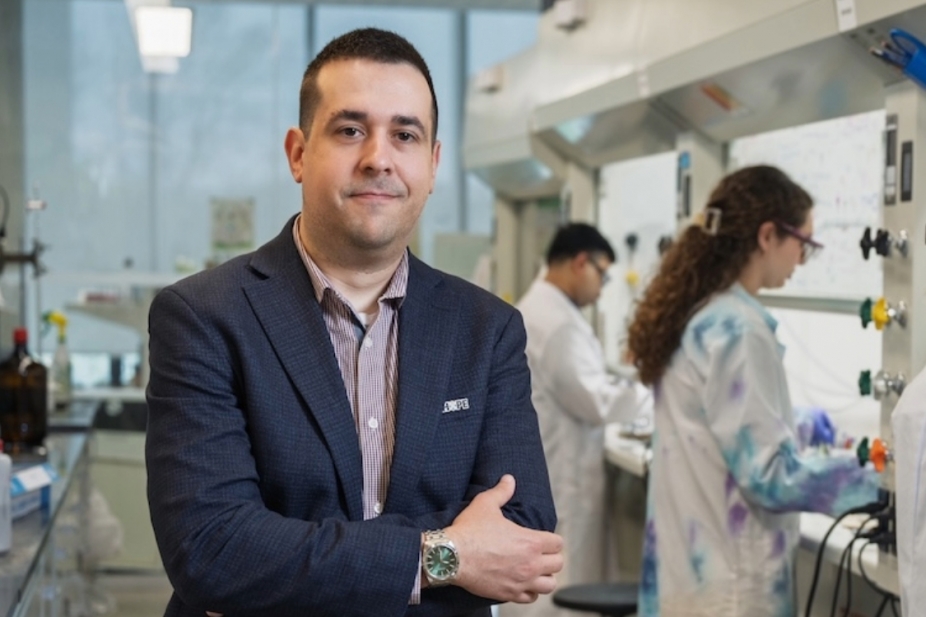
Dr. Simon Rondeau-Gagné will receive $400,000 from the Natural Sciences and Engineering Research Council of Canada (NSERC) as part of a larger $2 million National Science Foundation (NSF) grant through the Designing Materials to Revolutionize and Engineer our Future program. (PETER MARVAL/University of Windsor)
Simon Rondeau-Gagné is developing a new generation of smart, flexible polymer materials that could transform how technology interacts with the human body.
In the not-so-distant future, those materials could contribute to medical breakthroughs ranging from wearable biosensors that detect disease earlier to implantable devices that help restore vision.
“Our body does use electrical signals, but they are carried by ions moving from place to place, not by electrons the way they are in a computer chip,” says the University of Windsor chemist.
“The materials we create conduct both electrons, or electricity, and ions, making them compatible with both the human body and technology.”
Rondeau-Gagné’s expertise in semiconducting polymers is internationally recognized. He has been recruited to join a $2 million research initiative where he will contribute his next-generation materials to a cross-border network of researchers.
The project centres on implantable bioelectronic devices capable of repairing or replacing damaged biological signals — effectively teaching synthetic materials to speak the body’s language.
“These devices, which integrate with the biological system, have the potential to restore something that has been damaged or is not working,” says Rondeau-Gagné.
“For example, in vision loss, we could include a small chip made from our new materials and technology to help restore the signals, with the goal that someone could recover sight.”
His current work focuses on developing next-generation technologies using conjugated polymers and semiconducting materials.
“We want to take this opportunity to pivot into bioelectronics and make devices out of synthetic materials that could mimic biological systems,” he says.
“But the question is: can we include the right data or information and build those neurological systems?”
Rondeau-Gagné will receive $400,000 from the Natural Sciences and Engineering Research Council of Canada (NSERC) as part of a larger $2 million National Science Foundation (NSF) grant through the Designing Materials to Revolutionize and Engineer our Future program.
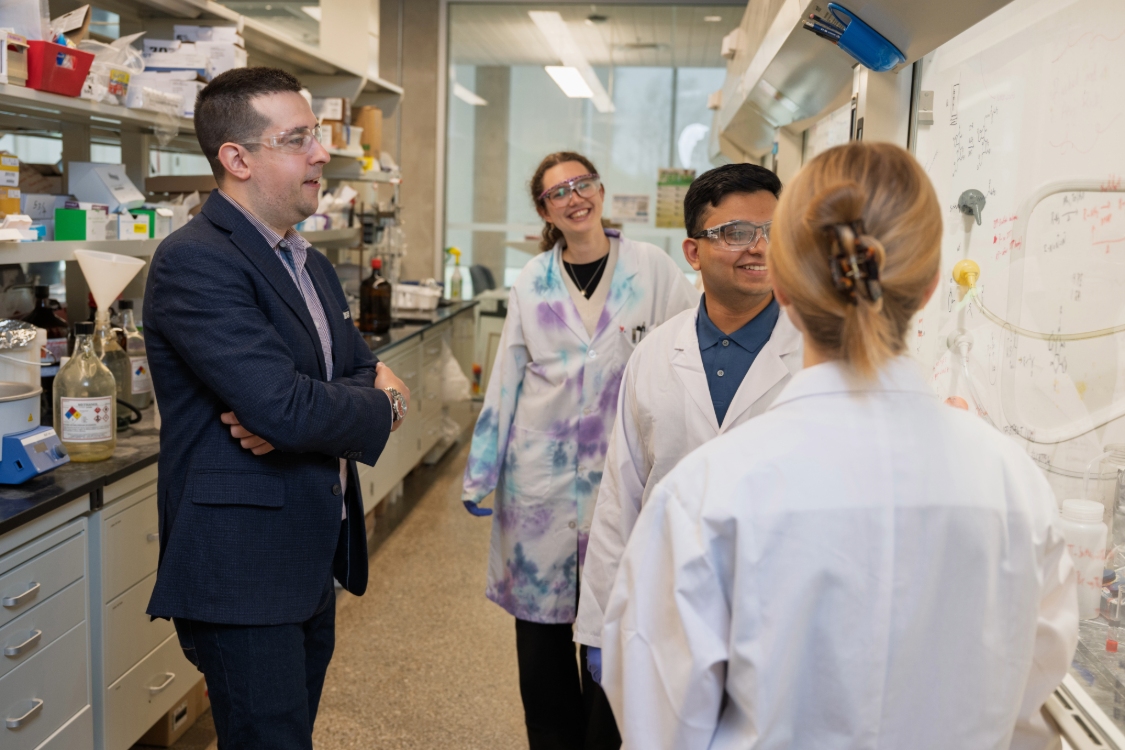
Dr. Simon Rondeau-Gagné is developing a new generation of smart, flexible polymer materials that could transform how technology interacts with the human body.
(PETER MARVAL/University of Windsor)
The international academic collaboration gives him and his team access to expertise from leading American research institutions, as well as new tools and technologies.
The initiative brings together researchers from the Massachusetts Institute of Technology (MIT), Purdue University, Iowa State University and the University of Southern Mississippi, with UWindsor serving as the Canadian partner. This project is one of eight NSERC partnership grants awarded across Canada.
The project will also use computational and data-driven methods to accelerate the discovery of high-performance polymers and better understand molecular design, processing conditions and device behaviour.
“By combining chemistry with AI-guided design, the team aims to dramatically speed up the discovery of materials that could power the next generation of wearable health sensors, brain-inspired computers and devices that could interface with the human body,” says Rondeau-Gagné.
These new materials could make future wearable biosensors far more compatible with the human body.
“This could lead to more sensitive, wearable biosensors that pick up faint signals from the body, like heartbeats or brain activity, and help connect the brain to machines,” he says.
“By mimicking how brain cells store and send information, this material could help build computer chips that think more like a brain and use a fraction of the energy of today’s technology.”
His lab will build and share a library of new materials with the research network.
Rondeau-Gagné says he has already begun exploring the field of bioelectronics through a WE-SPARK Health Institute Igniting Discovery Grant, taking a device-focused approach by developing a biosensor to detect breast cancer stem cells in breast milk.
“That research project lays the groundwork for a non-invasive, highly selective biosensor to improve early detection of postpartum breast cancer,” he says.
“By combining advanced polymer chemistry and bioelectronics, the team hopes to overcome current imaging challenges and improve personalized care and early detection for young mothers.”
Beyond the research and collaboration, Rondeau-Gagné says the project includes student training through cross-institutional internships and exchanges.
“This will take our expertise further than we could go alone,” he says.
“By understanding how to design materials better and finding smarter ways to use them, this network expands what’s possible.”
By Sara Elliott
Courtesy: https://www.uwindsor.ca/news/2026-08-17/smart-materials-could-help-future-medical-devices-speak-body%E2%80%99s-language