Science researchers take top honours at inaugural UWindsor Innovation Fellowship
Oct 22, 2026
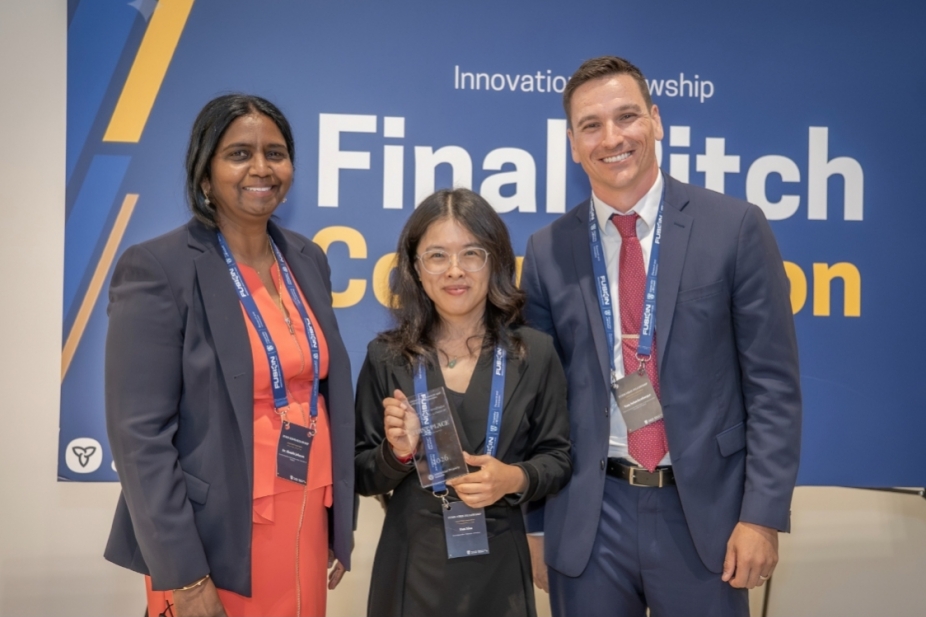
Dr. Dan Xiao won the inaugural UWindsor Innovation Fellowship.
Pictured with Dr. Shanthi Johnson (L) and Tom Schnekenburger (R). (KYLE ARCHIBALD/University of Windsor)
Three University of Windsor Faculty of Science researchers earned top honours in the inaugural UWindsor Innovation Fellowship for projects with potential applications in poultry farming, cancer treatment and chemical detection.
Dr. Dan Xiao, Dr. Brian DeVeale and PhD student Nathan Drouillard were among 10 fellows from across the University who spent 14 weeks learning how to turn their research into viable business ventures.
The program culminated in a pitch showcase where participants presented their ideas to a panel of investors, government partners and business leaders, competing for cash prizes and additional mentorship.
Xiao, a researcher in the Department of Physics, claimed first place and a $10,000 prize for her proposal to use magnetic resonance imaging (MRI) technology to identify infertile chicken eggs before they are shipped to hatcheries. She also received 30 hours of business mentorship through WEtech Alliance.
“Breeder farms produce eggs and sell them to hatcheries, which hatch the eggs and sell the chicks to farms that raise them for meat” Xiao says.
“We aim to identify infertile eggs before they enter incubation.”
Her proposed MRI-based method would allow breeder farms to screen eggs for fertility before shipping them to hatcheries, improving production efficiency. Because incubated eggs cannot enter the food supply, identifying infertile eggs beforehand could allow eligible eggs to be used for food rather than wasted.
Because breeder farms in most Canadian provinces operate under quota systems that limit the number of eggs they can sell, while payment is tied to the number of high-quality chicks produced, this technology could help them avoid shipping eggs that will never hatch.
Xiao's winning concept was not the one she brought into the program.
At the midterm pitch competition, she proposed using a low-cost MRI system to determine the sex of developing chicken embryos at small-scale hatcheries.
However, feedback from mentors led her to reconsider the commercial potential of her research.
“The potential market for fertility testing is approximately 20 times larger than that for in-ovo sexing,” she says.
Xiao credits the fellowship with helping her identify an opportunity she might otherwise have overlooked.
“Without this program, I don’t think I would have come up with this new idea,” she says.
“After the midterm pitch, we worked really hard and quickly put together a solid business plan. I think that’s what impressed the judges.”
Dr. Brian DeVeale, a researcher in the Department of Biomedical Sciences, earned second place and $5,000 for his proposed service.
(KYLE ARCHIBALD/University of Windsor)
DeVeale, a researcher in the Department of Biomedical Sciences, earned second place and $5,000 for his proposed service, Census Bio, which aims to improve how researchers identify patients most likely to benefit from specific cancer treatments.
“Cancer patients experience uneven responses to therapy - every medication does not work for every patient,” DeVeale says.
“Pre-identifying patients that would respond to a particular therapy would help candidate therapies achieve approval for use in patients through selective clinical trial enrollment and match patients with effective medications sooner.”
By identifying likely responders before treatment, the proposed approach could improve the evaluation of experimental therapies and help match patients with effective medications sooner.
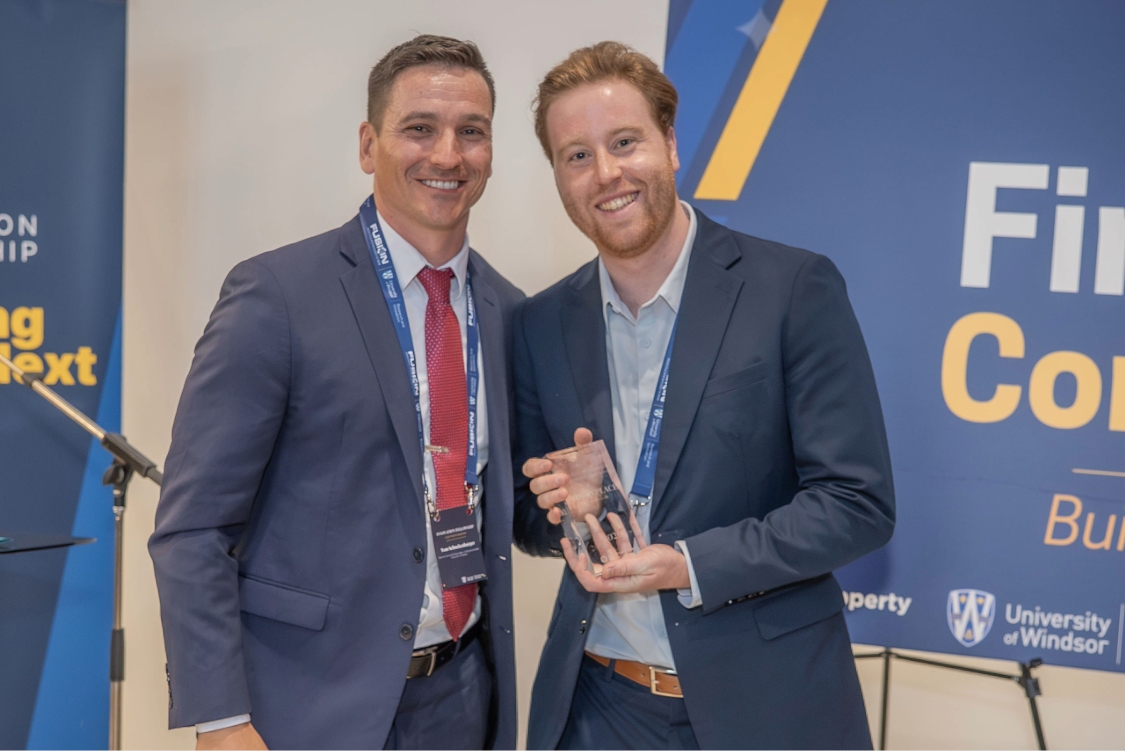
Drouillard, a PhD student in the Department of Physics, took third place and a $2,500 prize for his proposal to use laser-based techniques to amplify weak optical signals, making substances that are typically difficult to measure easier to detect.
Nathan Drouillard, a PhD student in the Department of Physics, took third place and a $2,500 prize for his proposal. Pictured with Tom Schnekenburger (L).
(KYLE ARCHIBALD/University of Windsor)
The technology could enable researchers and industry to detect chemicals, pollutants and other materials remotely or monitor them in real time, with potential applications ranging from water treatment to pharmaceutical manufacturing.
For Drouillard, the fellowship offered a new perspective on the possibilities for his research beyond the laboratory.
“Normally we have an idea, do an experiment, write and publish a paper and go to a conference,” he says.
“That’s been the biggest thing, learning how to potentially commercialize technology.”
The inaugural fellowship brought together 10 participants selected from a pool of 70 applicants. Each received $10,000 in initial seed funding from Intellectual Property Ontario (IPON).
Over 14 weeks, the fellows explored market validation, intellectual property protection and commercialization planning, developing the skills to move their research toward real-world applications.
Windsor-area business leader Shane Kilpatrick guided participants as the program's entrepreneur-in-residence, while delivery partner WEtech Alliance provided advisory services and support.
For Xiao, the experience demonstrated how quickly a research idea can evolve when scientists are given the tools to think like entrepreneurs.
“Without this program, it might have taken us 20 years to figure all of this out,” she says.
The Fellowship was made possible through $155,000 in funding from IPON to support the program’s delivery and funding to participants.
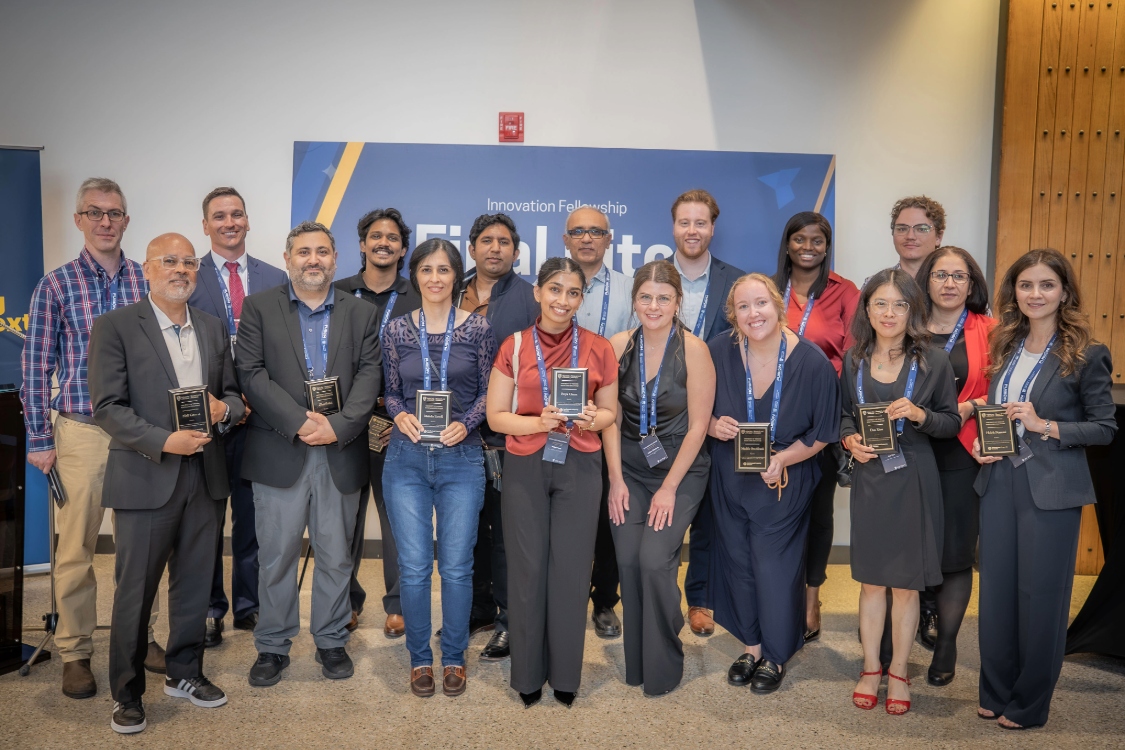
All the participants at the final pitch of the inaugural UWindsor Fellowship. (KYLE ARCHIBALD/University of Windsor)