Jun 24, 2026

Dr. Kemi Anazodo, professor at the University of Windsor’s Odette School of Business, is part of a research team studying employment outcomes for justice-involved adults.
(DAVE GAUTHIER /University of Windsor)
For people with criminal records, finding steady work can be one of the hardest parts of rebuilding their lives.
A new research project involving University of Windsor business professor Kemi Anazodo is examining how employment programs can help justice-involved Canadians overcome those barriers and build long-term stability.
Backed by a Social Sciences and Humanities Research Council Partnership Engage Grant, the study evaluates the John Howard Society of Ontario’s EMPower program, a 12-week employment training and placement initiative designed for people navigating the justice system and other structural barriers.
The project is led by Steven Smith of Saint Mary’s University, with Katelynn Carter Rogers of St. Francis Xavier University, Anazodo and the John Howard Society of Ontario as research partners.
“Ultimately, the goal is to generate evidence that can help improve employment programming for people who face structural barriers to work,” said Dr. Kemi Anazodo, professor at the Odette School of Business and a co-investigator on the project.
The stakes are significant.
Roughly one in nine Canadians lives with a criminal record, and research continues to show that stable employment is one of the strongest predictors of successful reintegration into communities.
The EMPower program was designed to bridge that gap by combining skills training, certifications and individualized supports with culturally responsive programming.
Participants — many of whom identify as Black or Indigenous, or who are newcomers to Canada — often face intersecting challenges, including discrimination, limited work history and mental health or addiction issues.
“What made EMPower distinct was its combination of structured employment training, individualized support and an intentional focus on culturally responsive programming,” said Anazodo.
The program includes pre-employment training modules, job placements and wraparound supports designed to build not only job readiness, but also confidence and long-term stability.
Over a one-year period, it was delivered to multiple cohorts, reaching individuals with complex and overlapping barriers to employment.
Early findings suggest the program is making measurable progress. Approximately 48 per cent of participants secured employment, while 42 per cent completed the full program.
“More participants found employment than completed the training component, which suggests that some were able to leverage skills and employer connections early,” said Anazodo.
Still, the research shows employment outcomes depend on more than program design. Employer perceptions, shaped by race, industry norms and the type of offence, continue to influence hiring decisions.
“Employer concerns about criminal records are not only about the record itself,” said Anazodo. “They are also shaped by race, industry norms, perceived risk and the type of offence.”
In sectors such as health-care and finance, criminal background checks are more commonly required for all employees, while other industries show greater flexibility depending on the role. This variability, researchers said, presents an opportunity to expand fairer hiring practices across sectors.
Christin Cullen, CEO of the John Howard Society of Ontario, said changing employer mindsets is a critical part of the solution.
“Criminal records are just not inherently useful predictors of risk or whether someone will be a good employee,” said Cullen. “What we do know is that employees with criminal records generally have lower turnover, equal or higher performance and no increased risk of misconduct.”
Cullen pointed to “fair chance hiring” practices, such as delaying background checks until after a conditional job offer, as simple but effective changes employers can adopt to widen their talent pool.
“If you determine you need to ask for a criminal record, only request it after a conditional offer has been made,” she said.
She added that fair chance hiring is not about lowering standards, but rather ensuring candidates are evaluated on their qualifications and potential.
“When you commit to giving all job applicants a fair chance, you expand your pool of potential talent to include a group of qualified candidates,” said Cullen.
The findings also highlight the importance of flexibility in employment programming.
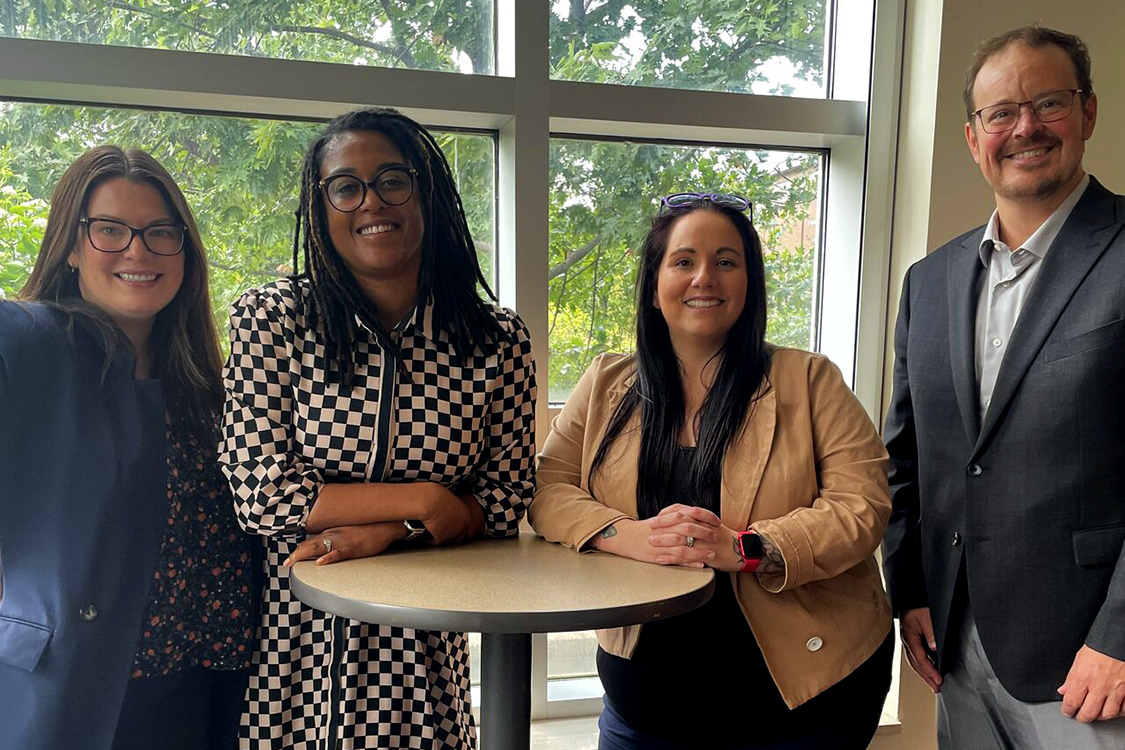
From left: Christin Cullen, John Howard Society of Ontario; Kemi Anazodo, University of Windsor; Katelynn Carter-Rogers, St. Francis Xavier University and Steven Smith, Saint Mary’s University, are part of a research partnership involving Saint Mary’s University, St. Francis Xavier University and the John Howard Society of Ontario examining employment outcomes for justice-involved Canadians. (SUBMITTED BY KEMI ANAZODO/University of Windsor)
Many participants require support beyond job training, including housing stability, mental health care and ongoing job retention assistance after placement.
“You can’t build a rigid 10-week program and expect consistent engagement,” said Cullen. “Employment programs need to meet clients where they’re at.”
For Anazodo, the findings reinforce a broader shift in how employment barriers are understood.
“The biggest issue is not whether participants are motivated or capable,” she said. “It’s whether employers and labour markets are ready to fairly assess people with criminal records.”
Cullen said the roadmap ahead requires both policy change and leadership from employers.
“We need continued investment in skills development and training, but we also need policy reform and corporate leadership to break down unfair and discriminatory hiring practices,” she said. “It’s time Canada follows suit.”
As the study continues, researchers will analyze participant data, employer attitudes and long-term outcomes to determine what works and for whom, with particular attention to racialized and marginalized communities.
“We’re not just asking whether the program works,” said Anazodo. “We’re asking how it works, for whom and under what conditions.”
By Victor Romao
Courtesy: https://www.uwindsor.ca/news/2026-06-22/fair-shot-work-uwindsor-researcher-explores-what-helps-justice-involved-canadians-succeed