Jan 07, 2026
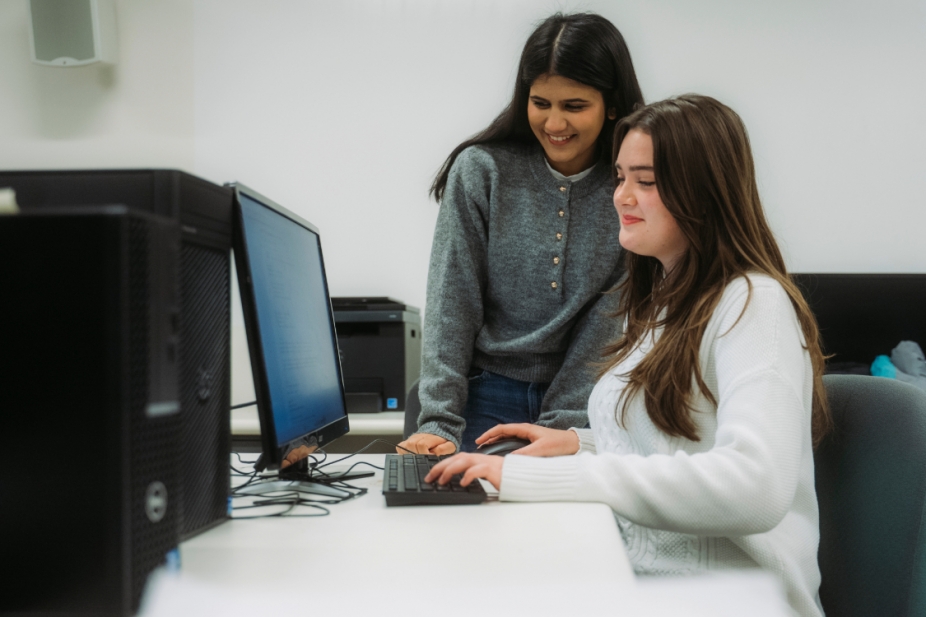
First-year engineering students Saxon Vandenwollenberg (seated) and Sneha Chitte (standing) helped to develop custom artificial intelligence models to help detect diabetic retinopathy and presented their findings at the 37th IEEE International Conference on Microelectronics. (MIKE WILKINS/ University of Windsor)
Researchers at the University of Windsor, including two first-year engineering students, have developed custom artificial intelligence models to help detect diabetic retinopathy — a leading cause of adult blindness — at earlier stages of the disease.
Their work compared four machine learning models, known as convolutional neural networks (CNNs), designed to analyze retinal images and identify patterns associated with the condition.
“We are using databases along with machine learning,” said Dr. Esam Abdel-Raheem, a professor in the Department of Electrical and Computer Engineering.
“This means we train neural networks (i.e., a network inspired by the human nervous system), where they contain nodes that receive signals and pass them through multiple layers, and the number of layers can affect how accurate the results are,” he said.
Researchers tested different neural network architectures, varying the number of layers and activation functions, to determine which setup produced the most accurate results in detecting diabetic retinopathy.
All four custom CNNs performed well, with three achieving higher accuracy and two demonstrating strong performance even without pretraining on a large dataset.
Abdel-Raheem said these deep learning techniques offer a promising alternative to traditional screenings at an eye doctor’s office and could help detect the disease earlier, which is crucial to slowing its progression.
Their findings were accepted and presented at the 37th IEEE International Conference on Microelectronics on Sunday, Dec. 14, by undergraduate students Saxon Vandenwollenberg and Sneha Chitte.
The paper was authored alongside PhD student and graduate assistant Sudipta Modak, who trained the students on machine and deep learning, under the supervision of Abdel-Raheem.
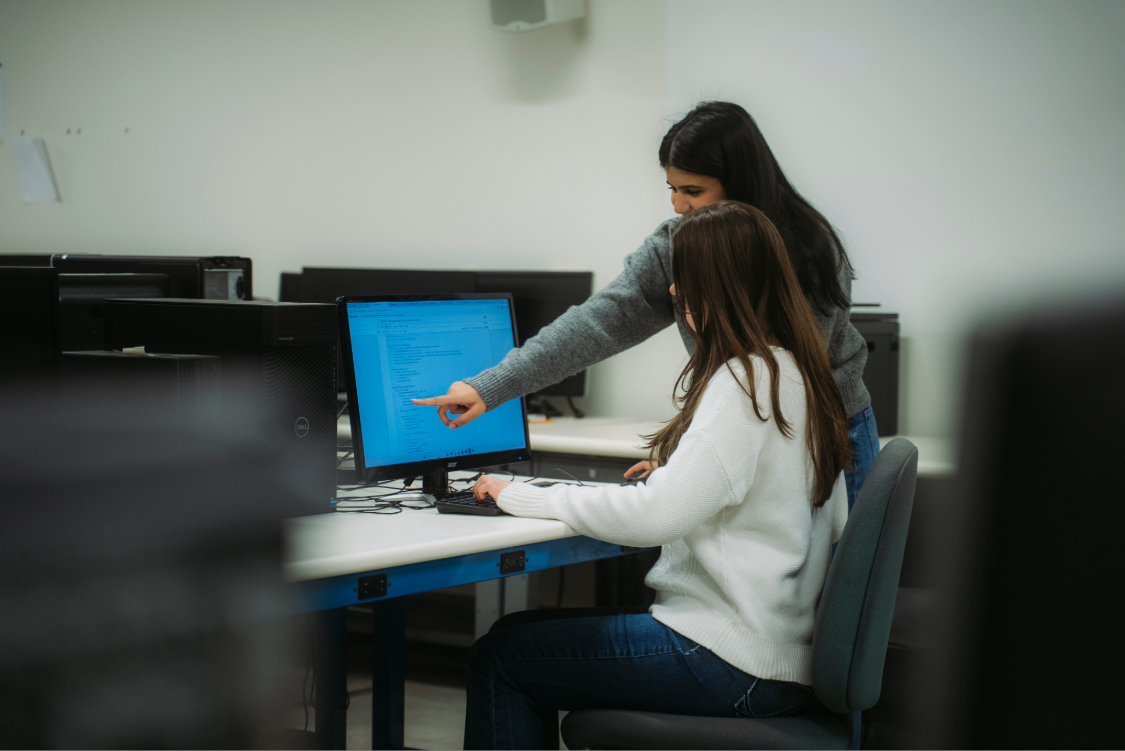
First-year engineering students Saxon Vandenwollenberg and Sneha Chitte helped to develop custom artificial intelligence models to help detect diabetic retinopathy and presented their findings at the 37th IEEE International Conference on Microelectronics. (MIKE WILKINS/ University of Windsor)
“Integrating AI and deep learning into the worlds of medicine and engineering is a very new concept. Being able to be involved with that at such an early point in our careers, we’re incredibly grateful,” said Chitte.
Publishing a conference paper was a rare achievement for the first-year students, and they were thrilled by the opportunity.
“When we found out, we couldn’t believe it,” Chitte said. “As first-year engineering students, you’re humbled a lot because the program is so challenging. We really weren’t expecting this.”
“It’s been incredibly motivating for us. It’s empowering and helps boost our confidence in our abilities,” Vandenwollenberg added.
Both students became involved in the project through the Elevate initiative, which provides research opportunities to undergraduates who identify as Black, Indigenous, female or non-binary.
With guidance from the research team, the students learned technical skills, lab protocols and how to communicate effectively in a research environment, describing the experience as invaluable.
“I’m really interested in the medical field and being behind the scenes to help advance medical technology. I hope to continue pursuing this type of engineering,” Vandenwollenberg said.
Abdel-Raheem said it is essential to provide younger students, especially those from groups underrepresented in engineering, with these opportunities, particularly in the rapidly growing fields of machine learning and AI.
“Students at any level can do this work. Modak, who is now completing a postdoctoral fellowship and is one of the most brilliant students I’ve worked with, trained them using the same methods from his PhD research, and they took it in stride,” he said.
“They were dedicated every day in the lab and at the computer, constantly discussing challenges. Producing research that was accepted at an international conference is incredible. We need to encourage younger students to pursue research because they can truly excel.”
Both Chitte and Vandenwollenberg applied to work with Abdel-Raheem because of their shared interest in biomedical engineering, describing the experience as an important step in their academic and professional development.
“It’s certainly a helping hand in becoming what you want to become,” said Chitte.
“We learned so many new things along the way — how to work in a lab, communicate with others, ask important questions — all the things you would learn in a professional environment.”
Now looking ahead, Chitte and Vandenwollenberg have been invited to continue working with Abdel-Raheem and are eager to pursue future research opportunities in the field.
By Lindsay Charlton
Courtesy: https://www.uwindsor.ca/news/2026-01-06/ai-research-uwindsor-shows-promise-earlier-detection-eye-disease