What a nursing student found in a neuroscience lab: Alzheimer's research and a career edge

Mar 11, 2026

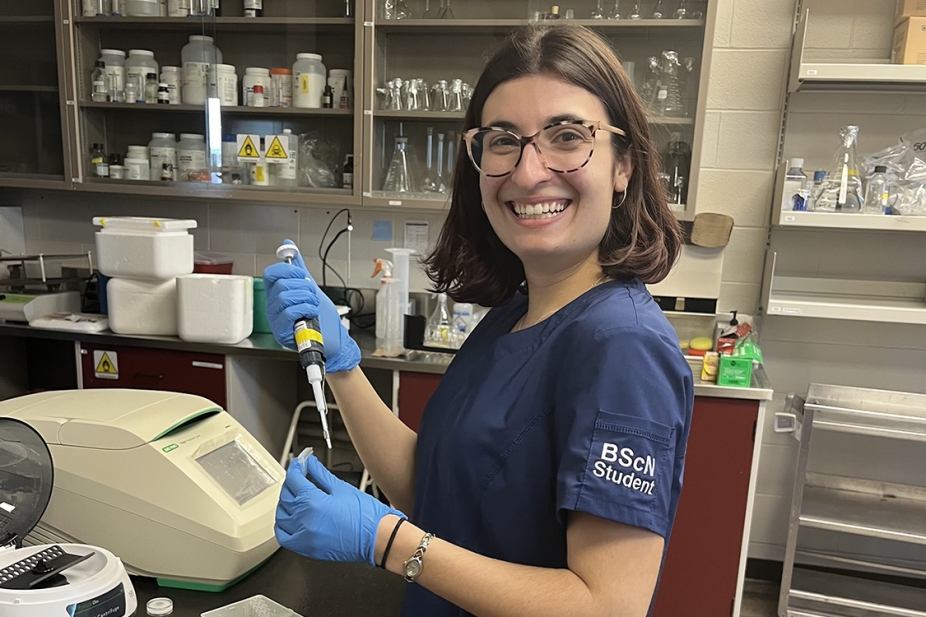
As part of the University of Windsor’s Outstanding Scholars program, nursing student Anna Papanastassiou gains hands-on research experience in a neuroscience lab, contributing to Alzheimer’s-related genetic testing. (ROGERS KOBOJI/University of Windsor)


Anna Papanastassiou spends most days in her nursing classes learning how to care for people.

But in a quiet neuroscience lab at the University of Windsor, she is also learning how to study the brain through hands-on genetic testing.

The second-year nursing student is part of the university’s Outstanding Scholars program, a competitive initiative that pairs high-achieving undergraduates with faculty-led research projects.

Although her placement is not directly connected to nursing, Papanastassiou says it has broadened her skills in surprising ways.

The role has immersed her in research techniques she had never encountered.

“I am mostly doing lab maintenance and genotyping,” she said. “I work with mice to identify their genetic lines, especially a gene linked to developing Alzheimer’s disease. Once we know the mice have that gene, the graduate students can run experiments on them.”

She began her placement in late September after advancing through the program’s multi-year selection process. Students apply in high school and spend their first year as candidates before submitting a more extensive application in second year. Only a handful of students from each program move forward.

While grades are part of the evaluation, Papanastassiou said the committee looks for more than academic performance.

“They want well-rounded students,” she said. “I talked about caring for my grandmother and performing in a community theatre musical last May. I think they valued that balance.”

Inside professor Dr. Vijendra Sharma’s neuroscience lab, she works alongside master’s and PhD students and sharpens her research literacy and technical skills. She has learned to analyze dense scientific articles, apply sterile techniques and present her findings during weekly meetings.

“I have grown a lot,” she said. “My professor gives me tons of articles, so learning to teach myself and figure out what is important has been a challenge, but a good one.”

The program also offers opportunities such as presenting at the university’s You Will Discover conference and attending leadership events. For nursing students, Papanastassiou said, the added scientific exposure is especially valuable.

“We do not take biology after a certain point in nursing, so I am grateful I get to keep learning the science side,” she said. “It will help me in my future career, especially with patients who have Alzheimer’s or other neurological conditions.”

Papanastassiou said her work schedule can be demanding. Outstanding Scholars students complete small projects for the program while maintaining regular lab hours. The balance depends largely on the expectations of the professor overseeing the placement.

“It is a bit of extra work, but it is the good kind,” she said. “You can put it on your resumé, your applications, your LinkedIn. It opens doors.”

Papanastassiou hopes her contributions may eventually lead to her name appearing in a publication. More importantly, she sees the work as an investment in her future, one that blends her interests in health care and research.

“Understanding Alzheimer’s pathology will help me with patients down the line,” she said. “It is all connected!”

By Victor Romao

Courtesy: https://www.uwindsor.ca/news/2026-03-10/what-nursing-student-found-neuroscience-lab-alzheimers-research-and-career-edge

Loading...