Mar 25, 2026
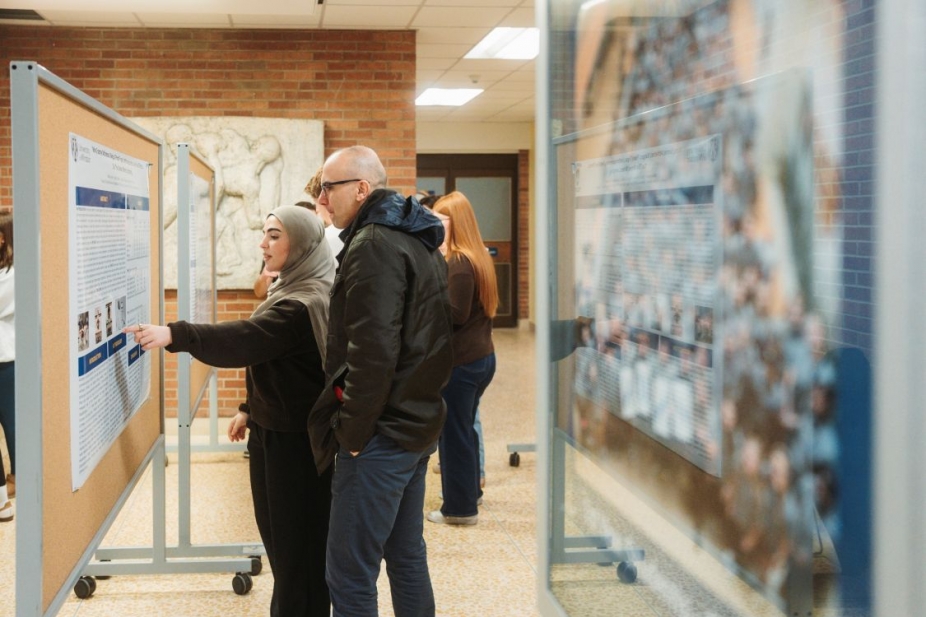
The 19th annual Kinesiology Research Day featured keynotes, a poster session and lab tours (MICHAEL WILKINS/University of Windsor)
Isabella Anes Rangel knows better than most the necessity of pivoting when life takes an unexpected turn.
A talented basketball player from a young age, Rangel’s athletic skill and drive set her on a trajectory from her home country of Venezuela to Canada as a high school student and eventually to the University of Windsor for an undergraduate degree in kinesiology.
As a guard on the Lancer women’s basketball team, however, Rangel experienced a career-ending injury, necessitating a sudden shift in how she engaged with sport.
This pivot was central to her address as one of four keynotes at the 19th annual Kinesiology Research Day, which took place March 18 in the Faculty of Human Kinetics.
Started in 2007 by Dr. Dave Andrews, KRD’s 2026 theme was Turns, Transitions and Trajectories: Research and Experiential Learning in Kinesiology.
“No matter how much you plan or dedicate to your goals, the path to reaching them is never smooth,” said Rangel, now a master of science in kinesiology and health studies student.
“Life will throw curveballs at you. But ultimately, what matters most — and what determines your growth — is how you respond to them.”
Rather than abandoning basketball altogether after her injury, Rangel responded by applying her experience to explore the mechanisms surrounding injury and training in players.
Working as a junior sports scientist with the Lancer men’s basketball team while she completes her MSc, Rangel combines her lived athletic experience with applied sport science, collecting data on training load to collaborate with coaching staff.
Her presentation at KRD, entitled “Get Touches,” summed up her advice for students unsure of what their paths might be. Getting touches, Rangel explained, refers to gaining exposure to a variety of experiences, research areas and fields to find out what you want to pursue.
“Being involved in research, even when you feel uncertain, exposes you to a wide range of experiences that help you better understand the field and yourself,” she says.
“Commit to the process, trust that each step is contributing to your development and allow your path to evolve. The right fit will come with time—as long as you keep moving forward.”
Taking chances on a variety of paths was also central to PhD candidate in kinesiology Ashley Flemington’s KRD keynote.
Flemington, whose path into kinesiology began as a strength and conditioning coach, had her own traumatic exit from sport, which turned her work toward exercise psychology and the role of mental fatigue, focus and attention during her master’s degree at McMaster.
Working with Ontario Baseball as well as starting her own business before taking the leap toward further graduate study, Flemington highlighted the way pathways in sport, academics and life are seldom straightforward.
Combining her experiences in coaching, research and sport, Flemington joined UWindsor’s PhD program in kinesiology and began research that combines theory and practice into exercise psychology and team dynamics under the supervision of Dr. Todd Loughead.
In addition to the two student keynotes, KRD featured a talk by Dr. Terry Eddy, emphasizing how twists and turns on the research journey are not limited to the grad school experience.
Eddy, a sports management and leadership professor, outlined his background from a pair of degrees in mathematics to a master’s and PhD in sports management, acknowledging plenty of doubt and uncertainty along the way.
Moving back and forth across Canada and the United States in various academic roles, Eddy too was “getting touches,” learning what type of role allowed him to thrive in the field.
Eventually landing at the University of Windsor’s Faculty of Human Kinetics, he shared this journey with students at KRD, highlighting the way that pathways in scholarship are rarely linear.
To close out the keynotes, Dr. Anthony Bain was recognized for his research and spoke about his work in integrative vascular physiology during a high-altitude expedition, emphasizing how fun research can be.
“It was very important for the KRD Committee to have keynote speakers discuss their journey and highlight that research is rarely a linear path,” explains professor Adriana Duquette, acting associate dean of research and graduate studies in HK.
“This is impactful for undergraduate students to hear early in their academic careers so that they are willing to get involved in all types of research, with the hope of eventually leading them on their chosen research path."
Following the speakers, KRD featured a poster session and an opportunity for students to visit various research labs across the faculty.
Students were able to ‘get touches’ as they learned about exercise science, physiology, psychology, ergonomics and other research opportunities, with the Sport Science Lab picking up the people’s choice award for best lab tour at the end of the day.
To learn more about research in Human Kinetics, visit the faculty’s website.
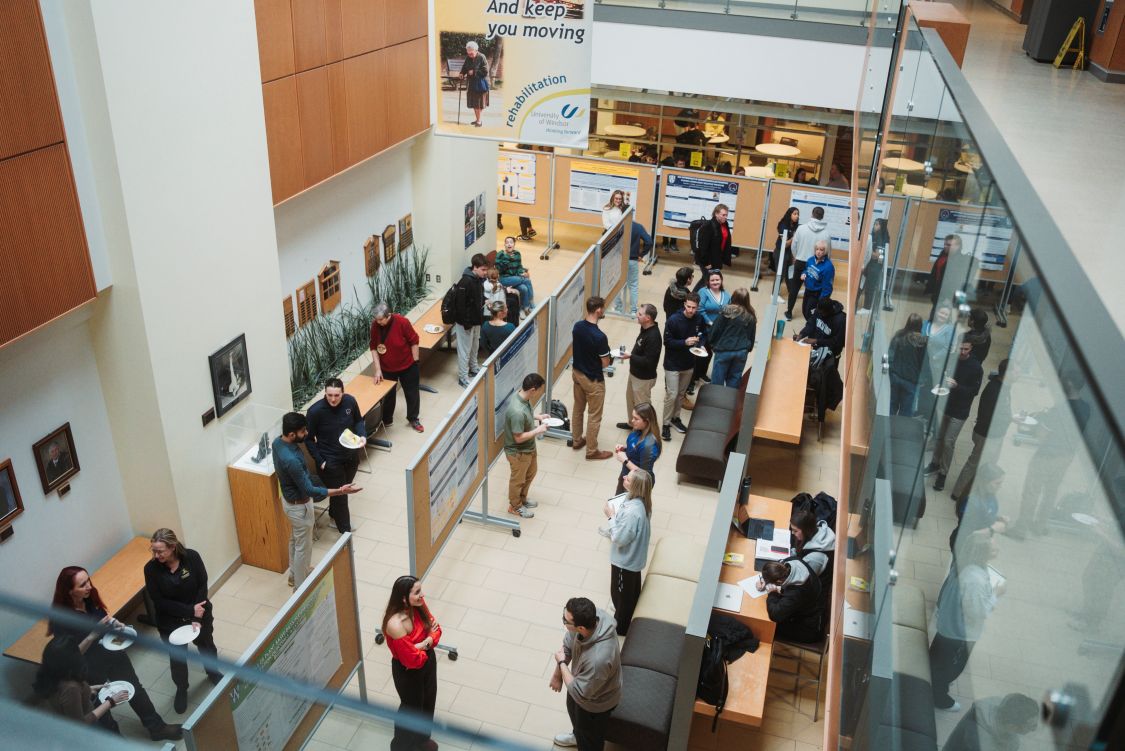
Kinesiology Research Day participants chat with student researchers during the poster session at the Human Kinetics building
(MICHAEL WILKINS/University of Windsor)
By Kate Hargreaves
Courtesy: https://www.uwindsor.ca/news/2026-03-24/kinesiology-research-day-embraces-turns-and-transitions-research-journey