Jan 21, 2026
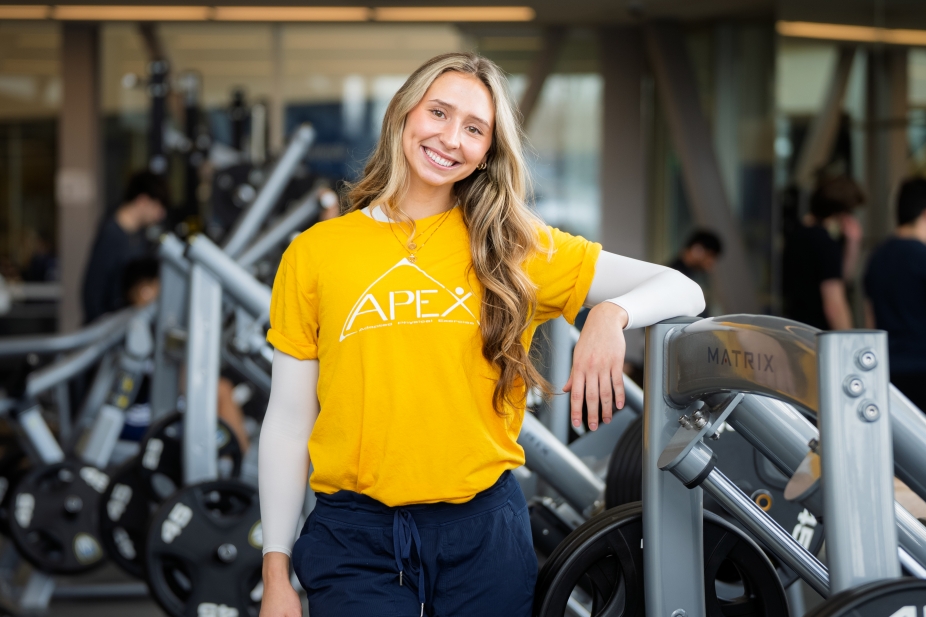
Chloé VidAmour is an APEX program coordinator, MSc kinesiology and health studies student, and Lancer track and field athlete
(DAVE GAUTHIER/University of Windsor).
In high school weight rooms across Essex County, leadership class students and students with disabilities are sharing in the joy of exercise.
Master of science in kinesiology and health studies student and APEX program coordinator Chloé VidAmour describes seeing these students build connections as “beautiful to watch.”
“We see this blossom of friendship,” she says. “It’s so fulfilling to see how much everyone loves the program.”
APEX, which stands for Adapted Physical Exercise, grew out of a partnership between the Faculty of Human Kinetics’ Centre for Human Performance and Health (CHPH) and Community Living Essex County 15 years ago.
As part of the APEX program, founded by Dr. Sean Horton and Prof. Chad Sutherland, community members with intellectual and/or developmental disabilities attend the Toldo Lancer Centre (TLC) for workout sessions with student volunteers.
VidAmour began volunteering with the APEX program as an undergraduate student in kinesiology in 2023 and enjoyed the experience so much that she wanted to continue into her master’s.
She eventually became a coordinator with APEX in the Community along with fellow master’s student Katie Morrison, led by Prof. Adriana Duquette as well as a team including Horton, Sutherland, and Dr. Paula van Wyk.
The APEX team began the community-based work with the Greater Essex County District School Board (GECDSB), offering professional development sessions about APEX and ways to adapt physical exercise for greater accessibility.
This led to a partnership with Essex, W.F. Herman, and Riverside high schools to broaden APEX’s reach out of the TLC and into the community, modifying it into a school-based model.
“We paired up with leadership classes instead of our student volunteers and with STEPS students instead of participants from Community Living,” VidAmour explains, referencing the Skills to Enhance Personal Success (STEPS) program for students with developmental disabilities in the GECDSB.
More recently, VidAmour and the APEX team have started programming with the Windsor-Essex Catholic District School Board, starting with Holy Names High School.
“We go into their school and use their equipment,” VidAmour explains.
“It can get a little crowded in the weight room, but everyone’s really good at being patient and waiting their turn.”
Leadership students are paired with STEPS students, or Life Skills students in the Catholic board, to lift weights and exercise together.
“The leadership student is their partner, their demonstrator, their support system,” says VidAmour.
“It’s very individualized. If someone doesn’t want to do arms that day, they can do legs. We encourage everyone to participate together so then they're both lifting weights together.”
Regardless of the school board or school, VidAmour describes APEX as being incredibly popular with the student participants.
“No one wants to miss APEX,” she says.
“Just enjoying the program and having a friend to exercise with is an awesome part of it.”
Outside the weight room, VidAmour says the relationships that are built during APEX sessions continue.
“APEX creates a community, whether in the TLC or in a high school,” she says.
“It turns into being friends and having that connection outside the gym. They start to say hi to each other in the hall, and then other students get to know their partner outside the gym. It truly has the potential to change school culture.”
Changing culture starts with challenging pre-conceptions volunteers may have about people with intellectual and developmental disabilities.
VidAmour’s research for her master’s program is focused on precisely this topic, examining neurotypical people’s perceptions of those with disabilities in the context of APEX .
“Volunteers need to learn not to underestimate their partner,” she explains. “Everyone’s different in their own way, even if you’re part of the neurotypical population.”
VidAmour also acknowledges her own growth through the course of her involvement with APEX.
“I’ve grown a lot and evolved as a person since I volunteered,” she says.
“The neurotypical population vastly underestimates someone with a disability, and as you work and exercise with them, your expectations rise to where they should have been in the first place.”
VidAmour is no stranger to the benefits of exercise as a varsity track and field athlete since 2019.
A triple-jumper, she balances practice five days a week (with double practices three of those days) with her research.
“I do think it helps my mental health to get a little break where I can go to practice and just forget about the work I have to do,” she says.
At the same time, VidAmour likes to stay in the moment instead of looking too far down the road at what’s to come.
After completing her master’s, she hopes to continue in the field working with those with intellectual and developmental disabilities.
“I love this program so much,” she says. “I'm always willing to come back and help as much as I can, whether that be in the University or in school boards.”
For now, however, she plans to finish up her degree, keep making connections and see what life throws her way.
Appropriately, for the APEX program, VidAmour says, “I think I'm just going to have to adapt.”
To find out more about APEX or get involved, visit the program’s website.
By Kate Hargreaves
Courtesy: https://www.uwindsor.ca/news/2026-01-19/lifting-weights-lifting-spirits-kinesiology-student-shares-joy-exercise-high-schoolers